BLOGGER TEMPLATES - TWITTER BACKGROUNDS
Showing posts with label beef. Show all posts

Friday, June 14, 2013

What to Eat?

Confused on what to eat organic and grass fed? Don't worry. I got your back. Someday I might even take my own advice.


Secrets of the Superhuman Food Pyramid: Benefits of Grass-fed Beef, Bison, Buffalo or Lamb
by BenGreenfield

File:Image of freshly prepared chateaubriand steak in the traditional style.jpg
From WikiCommons
 

Wednesday, June 12, 2013

If I Was a Guy... I'd 'Like' the View out the Kitchen Window on Facebook from the Bed


Ernest Hemingway wrote to begin writing, start with one true sentence. I add that to start cooking, or eating, start with one true ingredient. And the truest ingredient on Barclay Farms?

Beef.

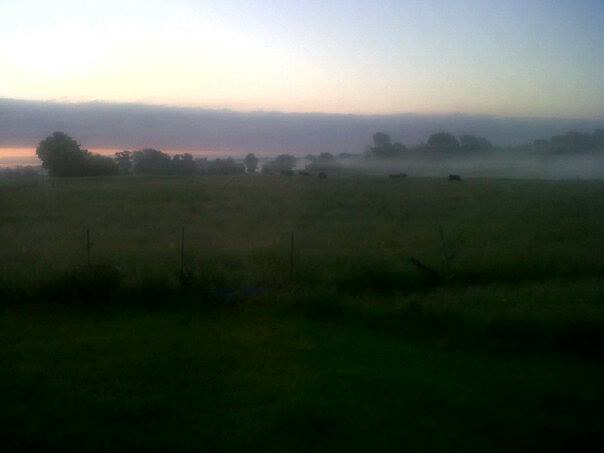
I woke early on Saturday and went to writing while the STC and Dairy Low-Tolerant Offspring still slept. I work Saturdays, but don’t go in until eight. It starts getting light out shortly after five, so when I came out of the Dungeon… err… sorry honey, the laundry room… err whoops, I mean, my office, the sky was just turning pink and the mist lay low across the field. The cattle are on our side of the road now, so we wake up to them in the side yard, or laying down by the pond.

It’s quite a horrible way to go.

So I look outside and there’s this impossibly beautiful, almost heartbreaking view of the sky, clouds, water, and cattle. I couldn’t convince the STC to stop cuddling the Offspring long enough to come look, but he did like the picture I posted to Facebook. From his phone. From the bed. Five seconds after I posted it.

Anyone else notice the irony here?

Oh well. It’s a good thing he’s cute. And makes a mean batch of smothered onions.

Speaking of which, my random creation of the week involved a 9x13 pan and a bunch of vegetables. Being too lazy to dirty another bowl in the five or ten minutes I had to prepare dinner after the Offspring cried himself into a temporary coma, I chopped a sweet potato, two smallish onions, one russet potato, and three enormous carrots into the pan, coated them with olive oil, and added eyeballed amounts of salt, pepper, fresh chopped cilantro, red pepper flakes, rosemary, and garlic powder. This bakes at 425-450 degrees, stir every fifteen minutes or so, more if it seems to be sticking. Oh, and I added the half can or so of home canned tomatoes we didn’t use from a recipe last week. That was a nice flavor as well. Anyway, that roasts at least an hour, if not an hour and a half. I eyeball it and go until the vegetables reduce and start to char a little around the edges. The last few minutes I like to stir it all around under the broiler, which is low broil on our stove, but might have to adjust for yours. It’s a super easy dish, all you do is chop, stir, roast, and it’s very healthy and great as leftovers. The only thing I miss about it is meat, but when the cows are so beautiful, it’s hard to want to eat them.

Until they run you up over a gate or slam your hand between the chute and their foot.

Then it’s open season.
Click to Enlarge

Tuesday, June 4, 2013

Michigan News: Smartphone Meets Steer

Now this is pretty f-ing cool.

Michigan Tracks Cattle From Birth To Plate

Invasion of privacy? Maybe. Pain in the place where the sun don't shine? Oh yeah. Especially for small farmers. And no one really mentioned if the RFID tags system was cost-effective or not over the last three years. But, if it did work, that's a great way to help the commercial beef industry connect with consumers.

Tuesday, December 7, 2010

A Lesson in Home Butchering

Last week my second to last cow finally calved. Ironically, she’s also the mother to the cow (10U) who has had a special needs calf, both of whom have been living in the barn for the past two months. 10U has a nice set of horns on her, rare in my herd, and has been high-headed since birth. She had her first calf this year and he came down with navel ill almost immediately and we’ve been messing with him ever since. (Jason and I were in bed one night going, “I’ve never seen that much puss.” So yeah, calvie was pretty gross.)

So the day Pammy calved, Dad and I decided little Shrek (10U’s calf) needed to be put down. We’d sold all our beef for the year and didn’t have any for our freezer, and since the cow kept charging Dad after he hand fed her ear corn for over sixty days, we decided a first-calve heifer would make a decent addition to the freezer for the winter. We didn’t have the extra money to have her butchered, since Christmas is coming, so, since it was deer season and the guys have honed their skills with butchering, we decided to butcher the cow ourselves. (Well Tom Bemrose and I decided, but that’s another story.)

Dad shot the cow and she bled out. Then we chained her back legs to the tractor bucket and drug her around to the west side of the barn. By this time, Jeff and Tom showed up after hunting all morning and not seeing a damn thing, and stayed to help. They’d done plenty of deer, so the thickness of the cowhide surprised them, but once we got the hide peeled back over her ass end, the weight of it drug it down her sides and we got to the head. Once there, we cut to the joint in her neck closest to the skull and kept paring until the joint showed. I was holding the cow’s head by the horns, rocking it back and forth so Jeff could sever the joint and when it went, it all went, hide, head and all, right to the ground.

We stopped to have a beer and study the situation.

Dad lowered the cow down and Tom carefully slit the belly, being careful not to puncture the intestines and drown us all in cow-gut stench. The intestines came out good, but Jeff and I had to hang Tom by his ankles so he could cut the esophagus out, dipping far down into her rib cage.

By then, all that was left to do was hanging the cow in the barn rafters and let her cure. A beef has to hang for fourteen days before cutting. We got her up without a hitch.

Last night on the way home I was listening to Michael Pollen’s The Omnivore’s Dilemma, another book that’s been on my reading list for some time. He talks about the feelings involved with killing the living thing that is to be your supper. I get asked about that a lot actually, doesn’t it bother you to eat the thing you’ve raised? The answer: no. I give my animals the best life I can. Many of my cows have been with me 8-12 years (which is longer than most of my romantic relationships all put together, which is neither here nor there). We expect the steers to end up on our plates and a cow is given every chance to have a successful place in the herd. If a cow is sour, like 10U, she only gets so many strikes, then it’s off to the stockyards or the freezer. I feel bad that we have to cull cows at all. If it was up to me, I’d keep every one of them. But that’s not the relationship people have developed with domestic livestock over the last millennia. It’s easier, I think, in a lot of ways to know the animal you eat. You’re there from day one, from inception, you see the quality of life they’ve had and give them as good and clean a death as possible. You’re able to treat the carcass with respect.

Butchering 10U could not have gone any better and I feel no moral pangs about it because I know the kind of life, and death, she had. When people are removed from the day to day life of animals, it’s easier to feel bad for them, to turn to vegetarian lifestyles, and condemn people who raise livestock for meat. I don’t agree with industrial style feedlots and the cows at work, in a confinement dairy, just about make me weep, but when animals are raised on grass and are allowed to have a strong herd unit, as nature intended, there’s nothing to feel sorry for. In fact, there’s a reverence that comes with harvesting your own food, allowing one to feel that much more connected to the food going into one’s mouth. There’s also the fact that butchering is such a big project that it takes several people to do it, so the social connection is there as well. In a digital, consumer, industrial world, connectivity, in person, is becoming the most important thing of all. And how much more basic can you get than getting together to butcher, swap stories, and remember the basics of being human?

P.S.

I didn’t want to post the pics here in case there’s some squeamish readers, but pics are on my Facebook.

Thursday, November 4, 2010

Resources for Farmers - And a Passion for Grassin'

So we’ve talked the last few days about grazing and why graze. I’d like to tilt the viewfinder a little today and give farmers out there some resources for grazing. Here’s one I found right off this morning that looks pretty fun, full of how-tos and fencing. http://www.ibiblio.org/farming-connection/grazing/home.htm. That one looks to mostly cater to beef, but a useful poultry resource for us has been http://www.attra.ncat.org/attra-pub/poultry/. Purdue also has some great info on grazing and pasture management http://www.agry.purdue.edu/ext/forages/rotational/index.html.

So hopefully that’s enough to get you started. I’ve got tons more resources, of course, but that’s enough to wade through for now, I think. One thing about it, it’s never hard to sell farmers on the benefits of grass. I think most of us would rather see our animals out on pasture more than anything else. The problem is that’s not where the demand of the market is. The demand is for cheaply raised meat that grows quickly and that’s exactly what the public has gotten, full of antibiotics and hormones. But, that is what they asked for.

Last I heard, less than 2% of the population is involved with food production in America, with fewer young people getting involved as the years go by. And when you think about it, why should they get involved? There’s little money and long hours involved with farming, passion for grassin’ or not. The key now is niche markets and educating the public on where their food comes from. I’m continually amazed at how many people my own age have never even been up close to a horse, let alone a cow. They have no clue about grass-fed versus grain-fed and no incentive to care. But food is the basis of everything. Without food, there’s no room for civilization. Farmers are integral to everything. I mean, how many people, realistically, can feed themselves without a grocery store? So there’s the incentive to learn about where your food comes from: no store, no eat. Scary. So my advice to aspiring and current farmers? Business planning.

I’ve mentioned Annie’s Project on the blog before, but for those who didn’t catch that post, it’s a nationwide class held to educate women in agriculture about opportunities and management in agriculture. For it, I picked up a lot of information on how to manage and build your farm on paper. This aspect of ag is actually a post or two all in itself so I’ll leave off today with a few starting resources on ag business and pick up tomorrow discussing the importance of business planning and how it can benefit your ag business.

http://www.michigan.gov/mda/0,1607,7-125-1568_2388---,00.html Haven’t explored this one yet, but does look to have some useful info.

The best site for farmers interested in business planning is https://www.msu.edu/~steind/. Dennis Stein is part of Michigan State University’s Extension Service and a great personality.

Here’s a link for beginning farmers and looks great for people just thinking about adding farming to their repertoire. After all, the reason most small businesses fail is poor planning. http://beginningfarmers.org/farm-business-planning/

Sorry for the tangent today, folks, but I get excited about ag and all its facets. I’ll try to be more focused tomorrow and more interesting to those who yawn their way through my rhapsodies over turf grass. Cheers.

Tuesday, November 2, 2010

Basics of Grass-fed Beef

I’d like to switch gears today and talk about ag, mostly grass-fed beef. I’m passionate about raising natural, happy beef. Cattle raised on grass are healthier, happier, and lead more fulfilling lives. Why is this important? you ask. Why should I care how my beef lives?

Here’s why.

Cattle raised on hormones and antibiotics typically live in stressful, crowded feedlots. While these types of situations are necessary to raise beef on a massive scale, smaller, more sustainable alternatives are available. While the demand for cheap, low-grade beef drives the market, if people demand higher quality meat, most farmers I know would love to oblige.

So check out this video from Purdue on the basics of grass-fed beef and we’ll resume this conversation.

So what’s the big deal about receiving nutrition from forages rather than grain? First of all, grass is healthier. According to eatwild.com, grass fed beef contains far higher levels of vitamin E, vitamin D, omega 3 fatty acids, beta-carotene, and conjugated lineoleic acid, or CLA, which has been linked to lower risk of cancer. Grain to cattle is like potato chips to us. It provides energy and puts on weight, which is good for cattle and bad for us. So if people consume beef that’s been raised on a poor diet, they have a poor diet, essentially eating what the cattle ate. Ruminates, such as cattle and sheep, are amazing in that they can convert grass, something humans can’t digest, into meat, which is something people can. Corn is highly inefficient for both people and animals. It’s hard to digest and is essentially made up of sugars that store to fat instead of muscle. The main benefit of grass-fed beef is that it is made up of salad greens instead of sugar cane.

This says it much better. Get back to basics, reality, and quality of life.

Tomorrow I'll talk about environment and how a grass-fed basis benefits humans and animals alike.