The FDA Doesn't Want Chickens To Explore The Great Outdoors
Even with the new city roosters who can't tell time crowing at all hours of the day and night, I'm still sticking with my free-range birds. Since we have twelve hens in our yard, not three thousand, and have had hens presumably interacting with wild birds for some years and have yet to have an outbreak of salmonella, we must be doing something if not right, then at least okay.
I read somewhere that chickens have a natural carrying capacity of two thousand or so, and getting above that number often led to outbreaks of disease. I wish I could remember where it is I saw this statistic, but even if it isn't right, we should remember that typically chickens haven't lived in the crowded, confined conditions that we have asked them to adjust to over the last fifty years.
Rather than scratch our heads and point at wildlife for spreading disease, maybe we need to look more closely at traditional methods of raising poultry and apply that to the commercial industry. That's probably heresy akin to suggesting crop rotation to get rid of root worm in corn, god forbid we use traditional methods to solve a problem we can pour pesticide on, but it's Friday, and my baby just woke up, so that's the best suggestion I've got.
Have a great weekend everyone.
Friday, July 26, 2013
Sticking with my Free-Range Chickens
Tuesday, July 23, 2013
Monday, July 22, 2013
A Monday Rant

This screen shot of one of my Google alerts illustrates the dichotomy present in the backyard poultry issue.
On one hand, chickens are the easiest species of livestock to raise. They come up quickly and certain breeds can be ready to butcher within six weeks. Egg layers will start producing between 18-22 weeks.
On the other hand, from what I’m reading, at NPR and other websites, because people have been disconnected from the raising of livestock, they don’t know how to be good managers. Not because they’re bad people, but because they lack experience and buy in perhaps a bit naively.
Life is all about cycles, and while I am not a religious person, there’s a lot of truth in that line about there is a time to live and a time to die. Let’s look at this plainly. Since the domestication of animals, we’ve raised them to die for us. They feed us, with milk or eggs; they clothe us, with wool and leather; and finally they feed us, with their flesh. Unless we’re vegan or vegetarian, this is the cycle. That we’ve removed slaughter from public view does not change the fact that it cost an animal its life to make your meal. If you or someone in your family is not willing to be the one to take that life, then maybe you need to rethink whether you’re ready for poultry. Broken legs happen, birth defects happen, roosters who chase the dog and harry small children happen, and if you’re too squeamish to put an aggressive or injured animal out of its misery, or find someone who can, that’s the big difference in mindset that separates farmers and non-farmers. Farmers don’t enjoy killing, but they are raised with the understanding that life is about cycles and every cycle has an end. And that end has to be dealt with quickly and humanely.
I guess what I’m trying to say is that it’s great that people want to raise chickens and I’m a firm believer that so long as they’re going to be good caregivers and maintain proper cleanliness for their residential standards, it’s fine to raise livestock wherever they’d like.
But raising livestock isn’t enough.
You have to have the wherewithal to humanely, even reverently, put down that livestock as well. We’ve raised these animals this way. It’s essentially our fault and our responsibility to ensure their well-being and happiness. Feeding us is their job, working for their well-being is ours. All the tree-hugging in the world won’t change that, so long as humans are the top predator, remain omnivorous, and maintain herds of domesticated livestock. We bred them to depend on us, for life and for death, and it’s our obligation as good caregivers, not to give them rights, but to maintain the best standard of care that we are capable of giving, for both the length of their life and their death.
For more information on abandoned poultry, try these thinks
http://www.npr.org/blogs/thesalt/2013/07/10/200699728/hipsters-off-the-hook-the-truth-behind-abandoned-backyard-chickens?ft=1&f=1053
http://millbrae.patch.com/groups/around-town/p/backyard-chicken-farmings-ugly-side-homeless-poultry_27225965
Wednesday, July 10, 2013
Scary Stuff on the Farmfront
As Biotech Seed Falters, Insecticide Use Surges In Corn Belt
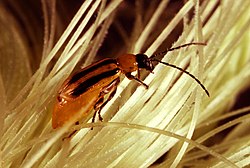 | |
| Western Corn Rootworm |
Sunday, June 30, 2013
Why does grass-fed cost more?
I can't even tell you how many times I've gotten variants of this question. "Why shouldn't I just go to Sam's Club and I can buy a hundred pounds of all steaks for cheaper than I can buy lower grade cuts from you?" First of all, if you ask me that question, go to Sam's Club. Second, I'm not sure what lower grade means. The best part about a quarter of beef is the variety. The STC and I have done amazing things with cube steak, sirloin, and chunks labeled "Lunch" out of the steer we processed at home because he would have run through the front of the trailer leaving an outline like a Looney Tunes character had we tried loading him for the butcher. So this article struck really close to home for me, and while I haven't run the operating cost for our farm, they don't sound that outrageous.
Why I Can't Raise a $1 Cheeseburger
 |
| From WikiCommons |
Monday, June 24, 2013
Farm Free or Die!
Okay, so I just really like this title. But the article brings up some important issues that small farmers face as well. Brings to mind the old adage to mind about milk your cow and keep your teeth together. Also, "just keep shoveling" seems appropriate.
Farm Free Or Die! Maine Towns Rebel Against Food Rules by Maria Godoy
*And I made up the adage about the cow and teeth.
Saturday, June 15, 2013
Spring Chicken
This opinion piece caught my attention. End sums up why we raise chickens pretty well. Even with the unsustainable price of feed.
And more chicken! Celebrate the alternatives to industrially processed meat By Julianne Glatz
 |
| From WikiCommons |
Sunday, June 9, 2013
Lady Farmer
This is just an awesome, awesome article. Really inspiring.
Hannah Breckbill [farms] “to work in something real and be the change I want to see happen in this world.”
With women accounting for 30% of U.S. farmers, there's a shift in agriculture. Be interesting to follow this trend of women and the move toward sustainable agriculture.
Breaking the grass ceiling: On U.S. farms, women are taking the reins By Lori Rotenberk
From: WikiCommons 
Thursday, June 6, 2013
On GM Crops from TIME Magazine
This is the most balanced view I've seen of the GM debate so far. Makes a very good point at the end about how GM and traditional plants and methods of intense and sustainable farming practices need to co-exist.
Modifying the Endless Debate Over Genetically Modified Crops
Read more: http://science.time.com/2013/05/14/modifying-the-endless-genetically-modified-crop-debate/#ixzz2UoLUjGAw
Tuesday, April 16, 2013
Humane Foie Gras and Letting Nature Work for You
Goal for our farm, but with cows. Give the animals what they want. Listen to nature and learn to solve problems, rather than imposing solutions on the farm.
Talks | TED Partner Series
Dan Barber's foie gras parable


 Posts


